

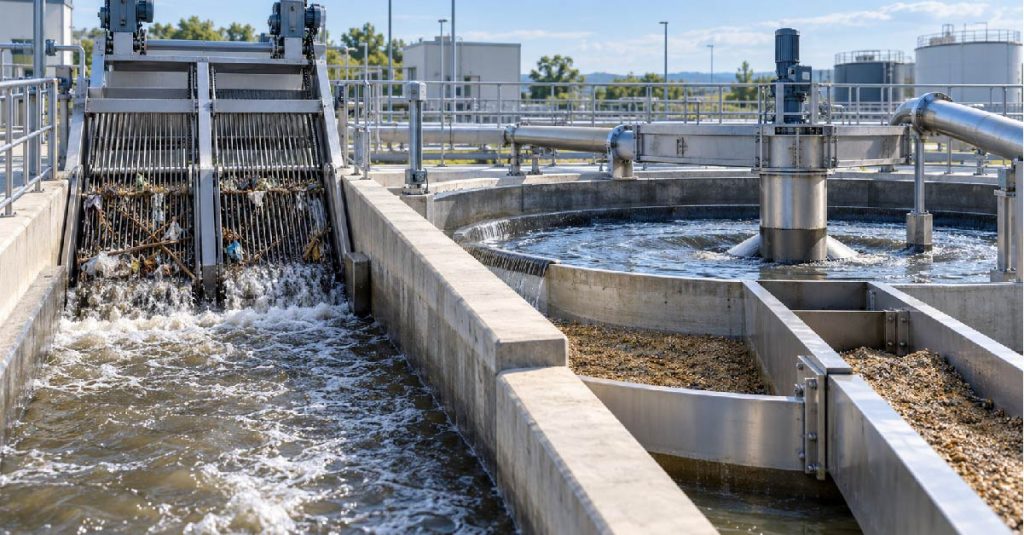
Walk through the inlet area of a wastewater plant after a difficult operating shift and the problems are usually easy to spot. A pump has choked on cloth or wipes. Sand has collected in a channel. Screenings have built up faster than expected. Someone from the maintenance team is already involved.
None of this sounds as technically interesting as membranes, biological treatment or water reuse. Yet these are exactly the problems that can disturb a plant long before the more sophisticated treatment stages get a chance to do their job.
That is the point of preliminary wastewater treatment. It deals with the unwanted material coming into the plant before that material becomes somebody else’s operating problem.
What happens during preliminary wastewater treatment?
The first part of a wastewater plant is mainly about protection.
Incoming sewage or industrial wastewater can carry far more than suspended organic matter. Depending on the source, there may be cloth, plastic, packaging pieces, fibres, sand, grit, small stones and other material that simply should not travel through pumps and treatment tanks.
Preliminary wastewater treatment removes as much of this troublesome material as practical at the inlet.
These front-end operations form an important part of sewage treatment and wastewater treatment systems.
It sounds straightforward on paper. In practice, neither is something plant teams should treat casually because the quality of this front-end separation affects maintenance throughout the facility.
Screening is simple in principle, but not always in operation
The purpose of wastewater screening is easy enough to understand. Wastewater passes through a screen and larger solids are retained.
What matters is what happens next.
Under normal circumstances, a screen may be faced with light debris; but in case of rain or a sudden or substantial change in wastewater characteristics the screen is going to be overloaded.
It means that the screening process used in wastewater treatment should be based not only on the size of screen openings.
A number of issues also need consideration: how material accumulates, which screen cleaning method will be used (manual or automatic), how screenings will be disposed of as well as how to ensure that maintenance personnel can easily access the screen for maintenance purposes.
Though the above problems appear rather easy to deal with, they define whether the chosen equipment will suit us.
Coarse screens allow removing big materials out of wastewater like rags, plastics and wood.
By contrast, very fine screens can remove little solids. While in some cases it is advantageous to have finer removal, it is not always practical.
This is because smaller openings provide greater amount of captured materials but also increase headloss problem due to poor cleaning.
Then there is grit, which causes a different kind of trouble
Sand does not wrap itself around a pump impeller. That does not make it harmless.
Dense particles tend to settle once wastewater velocity drops. Over time, that can leave grit inside channels, tanks and other parts of the plant. It can also contribute to abrasion of pumps and mechanical components.
Grit removal in wastewater treatment is intended to remove these heavier inorganic particles while allowing most organic material to continue to the next treatment stage.
That separation is more subtle than it first appears.
If conditions inside the grit chamber are wrong, material that should settle may pass through. At the other extreme, too much organic matter may settle with the grit, creating handling and disposal problems.
Horizontal-flow grit chambers, aerated systems and vortex units are all used in wastewater treatment process. The choice depends on the plant rather than on which technology appears most advanced.
Flow pattern matters. So does particle size, incoming grit load, space, energy use and maintenance access.
A plant receiving sewage from a sandy catchment, for example, can have a very different front-end problem from a plant where grit loading is comparatively low.
Why screening and grit removal cannot be treated separately
In most installations, the screen sits before the grit removal stage. There is a practical reason for that.
Big debris must be stopped before wastewater reaches the unit that is responsible for separating the really small and heavy particles.
However, arranging the two sections in the right way does not mean that they will work properly.
Hydraulic movements are also essential.
The channel design has an effect too because a poorly designed one will allow grit to deposit instead of going to grit chamber. Poorly maintained screen can create too high water level at upstream. Sudden changes in flow conditions will lead to separation inefficiency.
This is why it is important to consider not each separate mechanism used for sewage treatment but also the performance of the whole inlet system.
Average flow rates are good for design purposes, but there is much more that an operator deals with.
Look at operating symptoms before deciding what to replace
There is a tendency during plant upgrades to start with equipment.
That can be backwards.
Start with what the plant is actually experiencing.
Are pumps blocking repeatedly?
Is sand being found in places where it should not be?
Are operators manually cleaning channels too often?
Is the screenings volume unusually high?
Has maintenance increased even though the main treatment process has not changed?
These symptoms can also indicate that an existing wastewater treatment plant needs a process or equipment review.
For example, recurring blockages may indicate inadequate wastewater screening. Premature wear on equipment may justify a closer review of grit removal in wastewater treatment. Frequent channel cleaning could point to hydraulic conditions rather than a problem with one isolated machine.
The wastewater treatment screening process should therefore be evaluated using operating records, flow variation and actual incoming solids wherever possible.
That kind of review usually produces a better decision than replacing equipment simply because it is old.
Headworks problems have a habit of becoming plant-wide problems
A poorly performing inlet section rarely stays an inlet-section problem.
Particulate matter travels downstream. The material settles. The machinery requires upkeep. The operators put more effort in cleaning devices that they should not even have to use anyway.
The expenses pile up.
Additional machine work hours contribute to this.
Therefore, it is advisable to approach the preliminary wastewater treatment from a life cycle perspective.
The cheapest technology, apparently, is not necessarily the one that would cost less when the frequency of equipment cleaning, access in maintenance and consequences downstream can be taken into account.
At the same time the grit system that looks sufficient under normal operation conditions may turn out to be costly if it fails to function properly under those operating conditions that are actually responsible for the majority of the problems at the plant.
Where Ion Exchange fits into the discussion
Ion Exchange works across sewage treatment, industrial wastewater treatment, recycling, reuse and advanced water treatment.
That broader process experience matters because headworks decisions do not exist in isolation.
What passes through the screen affects downstream pumps. What escapes grit removal can affect tanks and mechanical equipment. The quality of the front-end treatment can influence how reliably later processes operate.
For a new installation, this means designing the inlet works around the wastewater and the treatment sequence that follows.
For an existing facility, it may mean looking beyond the equipment that appears to be failing.
Sometimes a recurring downstream problem begins much earlier in the process.
That is where a plant-wide review becomes more useful than treating every operational problem separately.
Final Thoughts
If blockages, sediment build-up or repeated maintenance have become routine, the issue may be worth tracing back to the inlet. Ion Exchange can assess the complete wastewater treatment train and help identify whether improvements to preliminary wastewater treatment could reduce operating problems downstream.
Good wastewater screening keeps rags, plastics and coarse debris away from equipment that cannot handle them. Proper grit removal reduces the movement of sand and other abrasive particles into the treatment train.
Together, these steps give the rest of the plant a better starting condition.
If blockages, sediment build-up or repeated maintenance have become routine, the issue may be worth tracing back to the inlet. Ion Exchange can help assess the complete wastewater treatment train and identify whether improvements in preliminary wastewater treatment could reduce operating problems downstream. Contact the Ion Exchange Malaysia team to discuss your wastewater treatment requirements.
Frequently Asked Questions
What is preliminary wastewater treatment?
It is the first stage of wastewater treatment where coarse solids, debris and heavy inorganic particles are removed before the wastewater moves into primary or biological treatment.
What is wastewater screening used for?
Wastewater screening removes items such as cloth, wipes, plastics and other larger solids that could block pumps or interfere with downstream equipment.
What is the purpose of grit removal in wastewater treatment?
Grit removal separates dense particles such as sand, gravel and small inorganic solids so they do not accumulate in channels or contribute to equipment wear.
What is included in the preliminary treatment of sewage?
The preliminary treatment of sewage commonly includes screening and grit removal. Depending on the plant, other inlet operations may also be included.
Why is screening in wastewater treatment necessary?
Screening in wastewater treatment reduces the amount of coarse material entering pumps, tanks and other treatment units, which can lower the risk of blockage and unnecessary maintenance.