

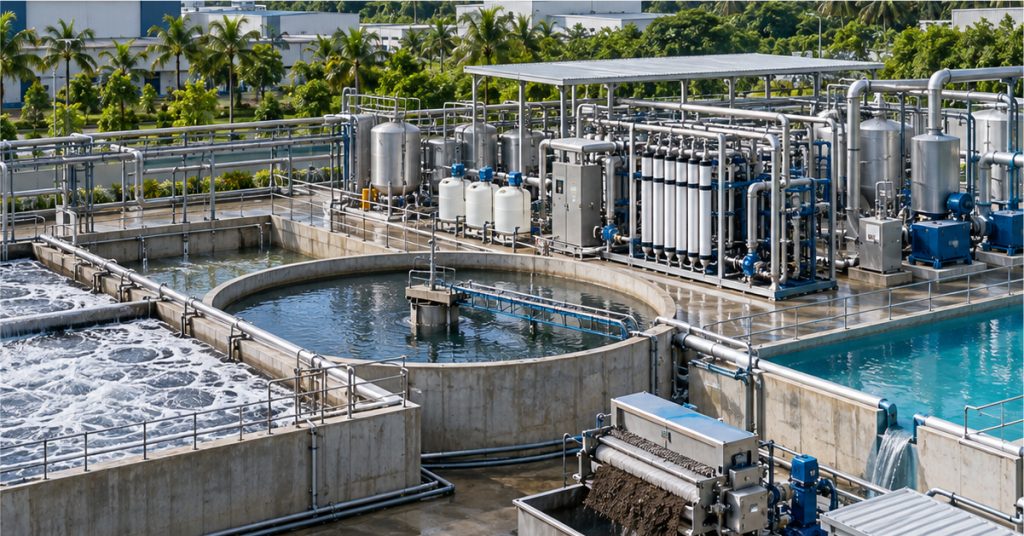
Malaysia’s water and wastewater treatment market was valued at an estimated USD 239 million in 2025 and is projected to reach USD 311 million by 2032, with a CAGR of 5.6%. At the same time, Malaysia’s New Industrial Master Plan 2030 is pushing manufacturing towards higher-value, technology-led and more sustainable growth.
That growth creates an obvious challenge: more industrial activity also means greater pressure on Wastewater Treatment Plants.
The compliance stakes have risen sharply too. Malaysia’s Environmental Quality (Amendment) Act 2024, effective from 7 July 2024, significantly increased penalties, with certain offences involving inland-water pollution carrying fines of up to RM10 million.
Thus, for plant managers and teams in charge of Environment, Safety and Health (EHS) principles, the process of upgrading has become more complex than just replacing obsolete equipment. Upgrading is now about meeting compliance objectives, ensuring reliability in production, recovering water from operations, and getting the operations ready to cope with future growth. This guide outlines when upgrades should be assessed, which technologies should be considered, and what suggestions should be followed for the treatment of industrial wastewater in Malaysia.
Ion Exchange Malaysia comes with tailored water and wastewater treatment solutions for the industry that are based on over 40 years of experience in the local market.
Why Malaysian Industries Must Act Now?
Malaysia’s Environmental Quality (Industrial Effluents) Regulations 2009 remain central to industrial discharge compliance. They prescribe acceptable discharge conditions under Standard A and Standard B, depending on where treated effluent is discharged.
For typical industrial effluent, Standard A includes limits such as BOD of 20 mg/L, COD of 80 mg/L for most industries, and suspended solids of 50 mg/L. Standard B permits higher limits for several parameters, but plants still need treatment designed around their applicable discharge location and industry.
The pressure is particularly visible in Selangor. Its Zero Discharge Policy initiative took effect following regulations gazetted on 20 June 2024. The programme uses discharge licensing, monitoring, and the polluter-pays principle while encouraging industries to reduce releases through practices such as effluent recycling.
Non-compliance is not simply an environmental issue anymore. For an industrial operation, enforcement, production disruption,n and reputational damage can quickly cost more than a carefully planned wastewater treatment plant upgrade.
Key Regulations Every Plant Manager Must Know
The regulatory environment can be categorized into four components. The Environmental Quality (Industrial Effluents) Regulations of 2009 govern the pollution of industrial effluents. Under the Environmental Quality (Amendment) Act of 2024, penalties for the most serious pollution offenses have increased. The DOE has created Online Environmental Reporting for industrial effluent, which has a reporting interface that captures the year and month of reporting.
In Selangor, the application of LUAS’ ZDP adds another layer for establishments that are defined under the Act. Licensed plants are monitored for discharge in both quantity and quality, with laboratory analysis reports sent to LUAS at specified intervals.
The significant lesson? Compliance with regulations should be used to determine the design of a wastewater treatment scheme for Malaysian industries instead of checking after the system has been commissioned.
Signs Your Wastewater Treatment Plant Needs an Upgrade
An industrial wastewater treatment plant rarely fails overnight. Performance normally deteriorates through smaller warning signs that operations teams begin treating as “normal”.
Watch for:
- Treated effluent repeatedly approaching or failing permitted DOE limits.
- Chemical consumption increasing even when production remains stable.
- Pumps, blowers, or other equipment requiring frequent repairs.
- Equipment that has been operating for a decade or more with limited modernisation.
- Production expansion pushing treatment flow or pollutant loads beyond original design conditions.
- Electricity consumption rising without a corresponding increase in treatment performance.
When several of these issues occur together, continuing to repair individual components may cost more over time than upgrading the process itself.
Top Upgrade Technologies for Industrial Wastewater Treatment
There is no universal technology for industrial wastewater treatment in Malaysian facilities. The correct combination depends on influent characteristics, available space, discharge requirements, reuse targets, and operating cost.
1. Membrane Bioreactor (MBR) System
Membrane Bioreactor Technology (MBR) merges biological treatment with membrane separation to generate high-quality effluent on a continuous basis. Having the feature of substituting traditional secondary clarifiers with membrane separation processes, MBR systems find their application in territories with limited space.
Thus, this technology finds its application in industries like pharmaceuticals, food processing, and electronics where effluent reuse is important, or higher-quality effluent is needed. Ion Exchange provides MBR wastewater systems in Malaysia for industrial purposes.
2. Advanced Oxidation Processes
Some pollutants simply do not respond well to conventional biological treatment. Advanced oxidation processes generate highly reactive species that can break down more persistent organic compounds.
This approach can complement an existing industrial wastewater treatment plant handling difficult streams from textiles, chemicals, pharmaceuticals, or other process industries. The important point is to use AOP where the wastewater chemistry justifies it, rather than treating it as a default polishing step.
3. IoT-Enabled Smart Monitoring Systems
Treatment plants should not have to wait for lab test failures to show them that something at their facility happened the prior day.
Today’s online sensors, connected devices, and analytics can deliver real-time measurements of important indicators as well as identify any deviations from normal operational conditions. This also aids the maintenance teams in identifying broken equipment sooner.
For many facilities, it can be one of the fastest approaches to modernization of their aged facilities.
4. Zero Liquid Discharge Systems
Zero Liquid Discharge takes water recovery significantly further by treating wastewater so that usable water can be returned to the process while liquid discharge is minimised or eliminated, depending on the selected ZLD configuration.
For water-intensive sectors such as textiles, chemicals and electronics, ZLD can reduce freshwater dependence while supporting more circular water management. In Selangor, where policy is increasingly focused on controlling effluent discharge and encouraging recycling, these systems deserve serious long-term consideration.
Industry-Specific Upgrade Pathways in Malaysia
Different factories create very different wastewater. That sounds obvious, but many poorly performing systems started with a treatment design that was too generic.
- Palm oil processing: High organic loads and challenging parameters can place heavy pressure on biological stages. Upgrades may focus on better equalisation, biological treatment, nutrient management,t and polishing before reuse or discharge.
- Food and beverage: Variable production schedules can create sudden changes in BOD, COD, fats and suspended solids. Better balancing and biological process control can make industrial effluent treatment operations in Malaysia considerably more stable.
- Pharmaceuticals: Complex organic compounds and micropollutants may require biological treatment combined with membrane processes or advanced oxidation.
- Semiconductor and electronics: Treatment often needs tighter control of pH, metals and process-specific contaminants. Water recovery can also be commercially attractive where high-quality process water is required.
The strongest industrial wastewater treatment plant solutions therefore begin with wastewater characterisation, not with a catalogue of equipment.
Cost, ROI and Funding for Plant Upgrades
Capital cost is usually the first objection to an upgrade. Operating cost should be the second question.
A more efficient plant can reduce chemical use, energy consumption, unplanned downtime and freshwater purchases. Water recycling can create another measurable saving. Against those benefits sits the financial exposure of non-compliance, which under the amended Environmental Quality Act can reach RM10 million for certain serious pollution offences.
Financing options have also evolved. Malaysia’s current GTFS 5.0 runs until 31 December 2026 or until its financing allocation is utilised. It supports sectors including manufacturing, waste and water, with government guarantee coverage of 60% to 80% of qualifying green-technology financing, subject to scheme requirements. Retrofitting projects can qualify where the eligibility conditions are met.
That makes funding worth investigating when planning a wastewater treatment plant upgrade, particularly when the project combines compliance with water or resource efficiency.
How to Plan a Successful Plant Upgrade: Step-by-Step
A disciplined upgrade programme usually follows five stages:
- Conduct an effluent audit and gap analysis. Establish current flows, pollutant loads, operating costs and recurring failures.
- Confirm applicable discharge requirements. Design around the actual DOE standards and local requirements affecting the facility.
- Evaluate technology against the wastewater. Compare lifecycle cost, footprint, energy demand, reliability and reuse potential instead of selecting equipment on capital cost alone.
- Select an experienced solutions provider. The provider should understand treatment chemistry, engineering, integration, and commissioning, not simply equipment supply.
- Implement, test and monitor. Commission the upgraded plant against defined treatment KPIs and retain continuous operating data to detect performance drift early.
For a wastewater treatment system Malaysia manufacturers can depend on for years, the audit stage is often more important than the equipment shortlist.
Why Choose Ion Exchange for Your Upgrade in Malaysia?
Ion Exchange has operated in Malaysia for more than four decades, providing customised solutions across water treatment, industrial effluent treatment, sewage treatment and related applications. Its Malaysian operation supports end-to-end requirements spanning treatment technology, engineering and services, giving industries a single partner for both new projects and upgrades.
Its local portfolio also includes MBR solutions suited to wastewater treatment and reuse applications.
The Time to Upgrade Is Now
Malaysia’s industrial growth, tighter environmental enforcement and improving treatment technology are changing the economics of Wastewater Treatment Plants.
Waiting until an ageing system fails a discharge test is rarely the cheapest strategy. A planned upgrade can improve compliance, reduce operating waste, support higher production and turn treated wastewater into a usable resource.
For organisations reviewing industrial effluent treatment Malaysia requirements or planning a new wastewater treatment plant Malaysia upgrade, Ion Exchange Malaysia can assess existing treatment challenges and develop a solution around the actual wastewater, site, and reuse objectives.
Speak with Ion Exchange Malaysia about your plant assessment and wastewater upgrade requirements. Contact Ion Exchange Malaysia
Frequently Asked Questions
1. What is the cost of upgrading an industrial wastewater treatment plant in Malaysia?
The pricing structure is not fixed because of the number of factors that determine the costs, including the capability of the plant, influent characteristics, existing infrastructure capacity and requirements for discharge, as well as the level of automation and requirement for reuse. A retrofit may entail only a few stages of the process, while the construction of MBR or ZLD plants may require higher investments.
2. What are the DOE effluent discharge limits for industries in Malaysia?
Malaysia’s Industrial Effluents Regulations 2009 specify Standard A and Standard B requirements. For most industries, Standard A includes BOD of 20 mg/L, COD of 80 mg/, L and suspended solids of 50 mg/L, although sector-specific conditions and other parameters also apply.
3. What is the penalty for non-compliance with wastewater regulations in Malaysia?
Penalties depend on the specific offence. Under Malaysia’s Environmental Quality (Amendment) Act 2024, certain offences involving pollution of inland waters can carry fines of up to RM10 million and imprisonment of up to five years.
4. Which wastewater treatment technology is best for Malaysian factories?
It is impossible to find only one best technology. MBR technology is the best choice where a clear effluent outlet and space are important. In the case of hard-to-treat pollutants, advanced oxidation will provide desired results, while zero liquid discharge is appropriate for plants working with a large capacity for water reuse. It is advisable to choose technology according to wastewater composition and regulatory obligations.
5. Can existing wastewater treatment plants be upgraded instead of replaced?
Yes. Numerous facilities are capable of enhancing performance by upgrading biological phases, membranes, tertiary treatments, automation, energy-efficient devices, or water reclamation facilities. An engineering audit will identify whether keeping existing assets is technically and economically viable before contemplating replacement.